
America
Tragic Drama or Absurd Farce
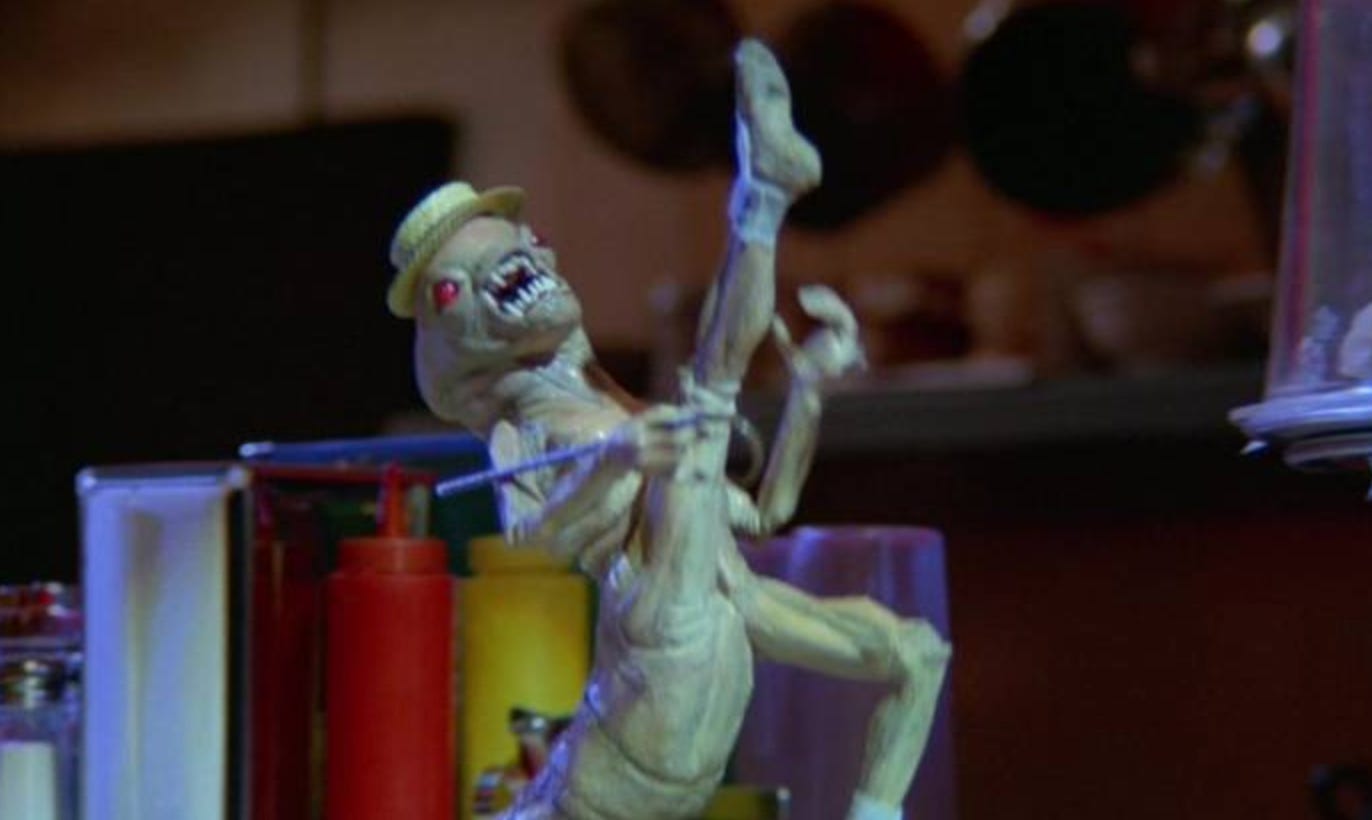
My god, this world.
T.S. Eliot once claimed that the end would come with a whimper, but this feels more like the grating voice of a drunk guy at a party who won’t shut up about his crypto portfolio.
What’s happening is not absurd in any high artistic sense; it’s just inane. Pathetic. Preposterous. And no matter how many times one reads about how authoritarians are “always slightly ridiculous figures,” or about how things happen “first as tragedy and then as farce,” the utter lack of seriousness combined with the scale and tenor of destruction is still astonishing. I am unable to think of a better comparison for contemporary America than the moment in Monty Python and the Holy Grail when King Arthur and his knights are about to reach to the sacred environs of Camelot, and then discover that what goes on there is mostly the singing of wacky songs and the performing of slapstick dance moves. The verdict? “On second thought, let’s not go to Camelot. It’s a silly place.”
America – in its democracy, its politics, its culture – is this silly place. But instead of high-kicking knights in clanking armor singing about pushing prams, we’re shooting protestors in the back of the head and dropping bombs on foreign lands, blowing up small boats in international waters and erecting monuments to the Dear Leader.
If you need a symbol of this moment, a single example that sums up the entire poking-ourselves-in-the-eye, dropping-a-barbell-on-our-foot-while-our-other-foot-grinds-down-on-the-throat-of-a-brown-person moment, consider the Supreme Court’s recent thought process (a generous description) in Louisiana v. Callais.
This voided Louisiana’s decision to create two Congressional districts that, because of who lived in them, would probably elect black representatives to national office. Louisiana has six total congressional districts, and the population of the state is somewhere in the vicinity of 32% black. Thus, having two black members of Congress seems reasonable; however, the suit was successfully brought by a number of white residents of Louisiana who claimed that creating such districts was racially discriminatory towards them.
How did our noble Lords of the Supreme Court reach such a fascinating decision?
In the careful words of Oyez, an educational website that does its best to present clear statements of what these decisions say and mean (like a squire shining up the armor of one of the Monty Python knights, making sure it’s presentable regardless of the silly uses it’s going to be put to) the ultimate verdict in Louisiana v. Callais is as follows:
To prove a violation of [the Court’s 2026 understanding of the law] a plaintiff must show…that minority voters have less opportunity than others due to intentional discrimination rather than politics or other race-neutral factors.
Remember that phrase, “intentional discrimination,” because it’s a doozy, the kind of bending of reality that a litigious fifteen-year-old attempts in the process of arguing that he shouldn’t be punished for plagiarism.
Before we offer up a critique of the monumental big-headed geniuses on the Court who invented this new rule, let us touch on several simple and really rather banal facts.
First, remember that the tradition of disenfranchising black voters in this country has a long history with its roots, obviously, in slavery. There have been two main moments of federal action taken against this. The first was just after the Civil War, when we enacted several Constitutional amendments making it illegal to deny people (men, actually, since women still weren’t allowed to vote) the ability to vote based on race. The second was in the 1960s, when Congress passed laws preventing Southern states from using all the sneaky/violent/socially corrosive/morally repugnant systems which they had been using for a century to avoid the post-Civil War Constitutional amendments’ guarantee of full enfranchisement for black folks.
Second, we should note that a certain proportion of American conservatives have always hated these laws and wanted them erased. This was true in 1870, it was true in 1970, and it is true in 2026.
Finally, remember that in 2019’s Rucho v. Common Cause, the august conservative star-children controlling the Supreme Court declared that gerrymandering along political lines (ie. Republicans or Democrats in a state using computer modeling to draw the districts such that only Republicans or Democrats in that state will be elected to statewide or national office) must always be constitutional.
Why is that last bit significant? Because it allowed said conservatives to make, in Rucho v. Common Cause, and then Louisiana v. Callais, a final two-step in their decades-long dance of grinding the face of America in the poopy diaper of their ideological fever dreams.
Functionally, the thinking (again, we’re being generous with that word here) in this set of incoherent-ramblings-that-is-now-the-law goes like this:
It is literally impossible to peer into the heart of another human being.
Therefore, unless someone says out loud that they are redistricting for racial reasons, it is impossible to tell whether they are actually doing it for racial reasons, because they could be doing it for political reasons. In other words, unless they say out loud, for everyone to hear, “We are doing this to intentionally discriminate against black folks,” there’s no way to tell if they’re really doing it for that reason or not. So, for example, if the legislatures in the states of what used to be the Confederacy enact redistricting rules in such a way that all of their black members of Congress are expelled and replaced by white ones (as those states are currently doing), it is simply impossible to tell if this is because they don’t want Democrats in office, or because they don’t want black people in office. It’s impossible, we tell you! Because, you know, there’s always a chance that it’s actually political gerrymandering.
Wait, what’s that? Political gerrymandering?! But didn’t the Supreme Court just give their blessing, in Rucho v. Common Cause, to political gerrymandering? You’re right, they did. And now, hold on, let me think… If racial gerrymandering can always actually be political gerrymandering if someone says it is, and political gerrymandering is always legal, is there any real way for the federal government to prevent racial gerrymandering? No sir, there is not.
My lord. And we’re all just supposed to pull at our beards and squint up through the smoke of our cigars and say things like, “Tragic, but that’s the law for you, isn’t it.” or “These little intellectual riddles are just so fun, aren’t they? Jeeves, fetch me a sherry.”
No, motherfuckers. It’s ridiculous. It’s a farcical string of legal decisions designed to pull us squarely back into Jim Crow, and you’re the only ones trying to pretend it’s anything else.

Seriously, we already have to live in a country awash with people who feel that putting a highly processed package of tobacco between your cheek and your gum because it gets you faintly high is the signal mark of manhood, and other (or maybe the same) people who believe that the single most important factor in deciding how to vote is whether they will be allowed to call people “pussies” and “faggots” and “retards” because that equates to “real freedom,” and as if that’s not enough, now you’re going to go and stack the Supreme Court with these kinds of people?!
Think for just a brief moment about the phantasmagorical logic at play here. Gerrymandering is somehow “illegal” if the map is drawn while thinking a single iota about race, but that exact same map is “legal” if it is drawn for the purposes of partisan advantage.
In the Willy Wonka world of the American conservative legal mind, the fact that both the “legal” and “illegal” courses of action are exactly the same makes perfect sense. It’s like the Supreme Court has ruled that burglary is legal as long as the burglar is singing the Oompa Loompa song, because it’s impossible to tell if, in his heart of hearts, the burglar is actually trying to steal something or just got carried away by the childish fun of the lyrics. And they’re not even going to make him give the TV back!
Even more risibly, conservatives bristle with indignation at the suggestion that this set of theories and beliefs and policies might be in any way, well… racist.
Are we allowed to suggest in polite company that the United States Supreme Court might be interested in elevating the interests of white people over those of black people? No! In fact, this is such a verboten idea that one hesitates to point out that it really is self-evidently true.
If it is the case that for conservatives there is no functional difference at all between gerrymandering for political purposes (legal) and gerrymandering according to race (illegal), in terms of their effect (reducing black elected representation in government), then it logically follows that that there is no functional difference between electing racists and electing Republicans.
As if by magic, the result of both choices is to somehow end up disenfranchising blacks. But, here in Monty Python’s America, we are supposed to accept the fiction that there’s no connection between the two.
“How dare you impugn us!” shriek the conservatives. “We believe in things like hard work and patriotism, jingoism and American values, and people are always accusing us of being racists!'“
“No,” respond the liberals. “We call you racists because it always seems to be the case that your policies come out worse for black people than they do for white ones.”
Now, this may have already seemed blindly obvious to you. Or it may never have struck you quite like this before, but now it does. “Why thank you, Tyler,” you might say. “No problem,” I might respond. “But, ah, what are you doing here in my monologue?” “What I’m doing here is warning you to have a care here, dear reader…
For this is not just idle speculation. Down these dark alleys of thought, danger lies.
Venture too far in this direction, and you may indeed have to confront the unsettling possibility that you are a sane person in an insane world.
Continue along this path, and you risk being the only one looking around gape-mouthed, gesturing up at the television, and saying, “Am I the only one seeing this?”, the only one tormented by the sheer idiocy of it all.
And what kind of a risk is that?
A terrible one, is the answer. For the feeling of believing that you are sane and yet being confronted daily by evidence of insanity all around you is utterly and unceasingly unbearable. It’s like being stuck in a sci-fi movie, and not in a kick-ass dark comedy kind of way. Not at all. Unless that movie was directed by John Carpenter, in which case it probably would be kick-ass in a dark comedy kind of way.
Anyway, the point is that if your answer may or may not lead you towards being the sane one in an insane world, that means there is a fair amount resting on this choice, and you may want to take some time before you decide whether or not you think that maybe, just maybe Johnny Roberts and Sammy Alito and the rest of the frat boys are right, and it all actually does make sense, if you really think about it?

Thank you for making me laugh in an insane world! And for reminding me of the creepy taxidermied frog band wearing sombreros I once saw in an antique mall in Wisconsin.
Hello my baby, hello my honey, your raggedy country is coming down and unfortunately taking the rest of the world with it.